
Attention stamina
Keeping your attention for longer, even when you do not enjoy what you are doing.
Play Attention
A computer program for attention and concentration. You wear an armband with sensors and control the on-screen games with your own attention.
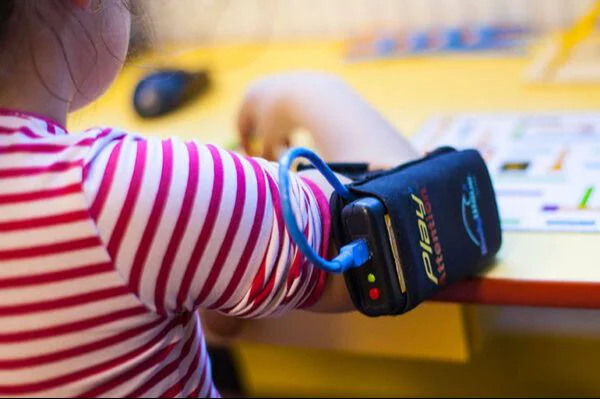
The Play Attention system uses BodyWave technology, developed to help NASA astronauts hold their attention. The program consists of five basic games and works with an armband with sensors connected to the computer.
When you focus on the object on screen, the character moves the right way. When your attention weakens, the object goes the wrong way or the game stops. To continue, you have to concentrate again. So you control the games with attention alone.
Significant improvements and changes can be seen after Play Attention. These changes are:
Daily life asks a lot of us: work, school, appointments. We make plans and to-do lists but do not always follow through. We skip a line, postpone something or get distracted. Then it is hard to direct our attention where it belongs.
Attention is made up of several skills. You need to remember things (memory), not jump impulsively to another task (impulse control), filter out distractions (friends, the internet, social media) and finish what you start.
Play Attention brings the systems involved together under one roof. It is the only program that combines feedback technology with cognitive skills and behaviour shaping.
Keeping your attention for longer, even when you do not enjoy what you are doing.

Holding attention by following a moving target, like a teacher walking through the classroom.

Starting quickly and focusing until it is done. Helps with procrastination.

Holding sequences and information long enough to work with them, such as multi-step instructions.

Quickly telling stimuli apart so you filter out distractions and stay on your work.
Children and adults with attention problems can often game for hours, because games stimulate the senses enormously. Classrooms, homes and workplaces cannot compete. Listening, reading and writing are not very stimulating for many people.
Play Attention uses low-stimulation games with auditory and visual elements that support concentration. You need no hand-eye coordination: you play by paying attention. A coach monitors behaviour and progress and guides the process.
Attention can be seen as the synchronised cooperation of brain cells. A comparison: attention is the conductor of an orchestra. Each musician plays their own note, but with a conductor they play together. ADHD is a misnomer for many things. People with ADHD do not actually have attention deficits. What people with ADHD lack is control over their attention. As a result their attention gets spread over many stimuli. In other words: their conductors struggle to conduct their orchestras.
The brain keeps changing through learning and our environment. This is called neuroplasticity. In Play Attention you practise steering your attention and see on screen at once what it does. Attention becomes something concrete you can practise.
As in sport: practice makes perfect. It takes time, repetition and consistency. Even with serious attention problems, skills can be learned. Play Attention also works on organising, finishing tasks, ignoring distractions, following the teacher and memory.
Learning requires paying attention to the teaching method and taking in the information. That lets new knowledge be organised and linked to earlier knowledge. Without attention, information passes less easily from short-term to long-term memory, which can lead to forgetfulness.
Attention problems rarely come alone. Stamina, time on task, visual tracking, short-term memory and ignoring distractions often play a part. Those are exactly the skills Play Attention works on.
Our brains consist of billions of cells that communicate with tiny electrical currents. In neurofeedback this electrical activity (brain waves) is measured, for example with an EEG, and shown back as a graph or a game. You get feedback on what your brain is doing and see when you are focused and when you are not.
Play Attention reads brain signals to measure attention, but the goal is not to change brain waves. We aim for visible, performance-oriented results: doing homework, organising yourself, ignoring distractions and following instructions. That matters at home, at school and at work.
Play Attention has existed since 1994 and is used in over 600 schools in the US alone, and in thousands of homes, schools and counselling centres worldwide. Attention training is patented because of the combination of learning skills and behaviour shaping.
You can buy the device and use it at home, or have the sessions guided by a Play Attention coach at Piek Attention.
They can buy the device for pupils or employees. We provide the necessary training for your staff. Our coach can also guide on site.
It usually takes at least 4 hours to learn to use the software. Training is face-to-face or online and an electronic manual is included. We recommend a free introduction session.
To order or ask questions, contact us via the email address or phone number on this website.
Software, BodyWave arm device, interface box, Bluetooth device, user manual, behaviour shaping charts, behaviour management materials, free technical support, extensive phone training, interactive guide with audio and video, and an unlimited user licence.
The same components with 2 user licences. The user licence determines how many users may legally use the program.
Anyone from age 6. Especially people with ADHD or concentration problems, people who want to work more efficiently and people preparing for exams.
In regular games, effects and graphics stimulate the senses, so anyone can concentrate without training attention. In Play Attention you use no controller: the player’s attention controls the game, with low stimulation.
You can make progress, but 40 sessions are recommended for lasting skills.
Sessions of 30 to 45 minutes, 2 to 3 times a week, or 10 minutes daily. Practice makes perfect.
No. It takes brain power. Sensors in the armband measure signals indicating focus and cognitive processing, so you move the characters with attention alone.
No. It has no side effects.
No. Play Attention can be used by anyone who wants to improve their attention.
Play Attention is an educational tool that teaches skills that cannot be learned with medication. Talk to your doctor about the medication.
All decisions relating to your health must be made by you and your doctor.
There is no greater danger in using this product than in using a phone.
It is not possible to use Play Attention too often. It is advisable, however, to use the product as stated in the safety instructions.
Either. You can have sessions guided by a Play Attention coach at Piek Attention, or buy the device.
Book a no-obligation introduction call or ask your question.